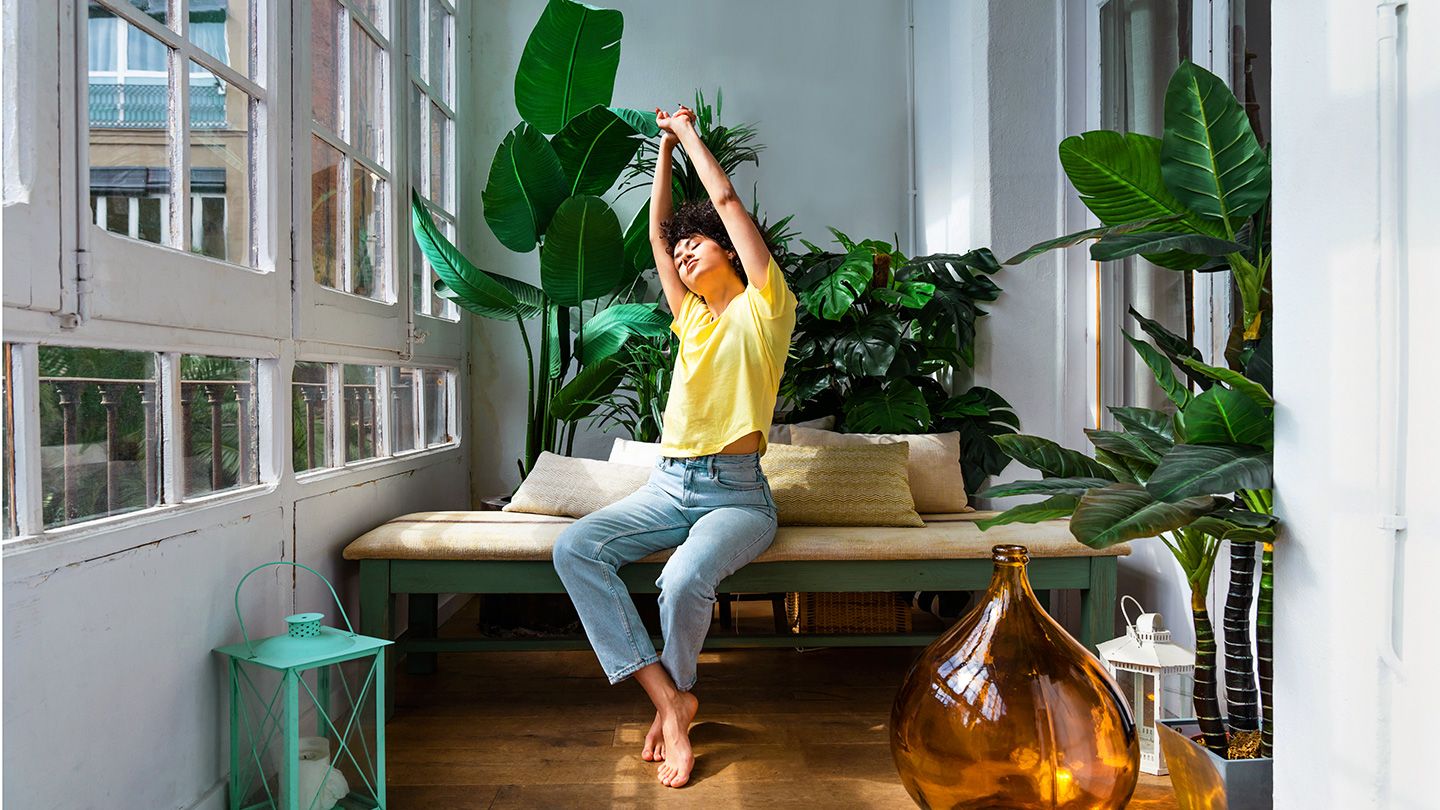
Does waking up to soft sunlight streaming in through big sliding glass doors and the sound of birds chirping and waves crashing nearby sound relaxing? That might be because your environment — the sounds, smells, light, and physical objects in your space — can affect your mood.
This article explores the link between your surroundings and peace of mind, and offers science-backed ways to brighten your personal space and mood at the same time.
How Your Personal Space and Mental Health Are Connected
Some experts theorize that the link between your personal space and mental health is rooted in your evolutionary past.
“Think about the sensory experience we would have had eons ago. A visually cluttered grassland or savanna would make it hard to see danger approaching and would make you feel very tense,” says Sally Augustin, PhD, a practicing environmental and design psychologist and the principal at Design With Science.
Visually cluttered spaces still tend to elicit the same response in modern humans, she says. One study found that perceived home clutter directly impairs mental well-being and life satisfaction in adults by damaging their perception of the home as a restorative sanctuary.
It’s not just what you see that makes a difference. “All sensory experiences combine in your head and mix like ingredients, blending into a common entity that contributes to your emotional response to a space,” Dr. Augustin says.
Your brain processes all possible inputs — sight, sound, smell, touch, and taste — in concert. Evidence suggests that your senses can make you feel more relaxed, more energized, and even more anxious. For example, the scent of a romantic partner’s shirt can reduce self-reported stress and cortisol levels, likely due to positive associations with that scent.
This is due to personal experience and preference (such as the smell of the jasmine that your grandmother grew on her front porch, which evokes nostalgia and positive memories), as well as ingrained biological responses designed to keep humans safe in an unpredictable world.
Even infants who haven’t developed the cognitive control necessary for conscious, sensory-based emotional regulation can experience reduced fear responses during stressful situations when exposed to skin-to-skin contact or their mother’s scent. This indicates there’s both a learned and an ingrained biological response to different forms of sensory input and experience.
So, yes, it’s possible to hack your personal surroundings to curate the mood or experience you want. When you optimize an environment for better mental health, Augustin says that the results can include improved cognitive performance, better relationships with others, and clearer thinking.
Here’s how to get started.
1. Open Your Blinds to Start Your Day Right
To start off your day energized, one of the best things you can do is to let natural light stream in. “Open your drapes, sit facing the window, and get as much natural light as possible,” says Augustin.
2. Play With Mirror Placement in Darker Spaces
While you may not be able to add windows to your home to increase natural light, there’s another hack that can help: hang more mirrors.
“A quick fix for spaces lacking natural light is to place mirrors on walls across from windows,” says Amber Dunford, a design psychologist and the style director at Overstock.com. “The mirror will reflect the view and bring in the outdoor lighting, making your space appear brighter and larger.”
3. Make a Morning Wake-Up Playlist
Start your day on the right foot by listening to a playlist filled with happy, upbeat songs.
“Aim for songs that make you smile, get you dancing, and have a beats per minute (BPM) between 100 and 130,” says Hughey. The BPM is the tempo of the songs you’re listening to.
A study published in 2025 had participants complete a questionnaire, then tracked their brain activity using an electroencephalogram (EEG) while they listened to piano pieces with varying tempos up to 156 BPM. As the tempo of the music increased, listeners experienced heightened emotional arousal and positive moods, which corresponded directly to increased neural activity in brain networks associated with excitement. However, slow tempos were also associated with calm, and high tempos with anger.
Music is highly personal. You can curate your list carefully and pick music you truly love, rather than relying on a generic happy or morning playlist from an app.
4. Clear the Clutter
That stack of mail you haven’t had time to go through or the mishmash of kids’ schoolwork, toys, and laundry that piles up may be more distracting than you think.
“Clutter can make us very tense and distracted, and trigger survival instincts that harken back to the earliest days of humankind, similar to the instinct to scan a tree line or forest for potential predators,” says Dunford. This can even apply during childhood: A study found that children and mothers playing with five toys (especially organizational toys like blocks) had more sustained focus and higher interaction quality than those who had joint play with 12 toys.
Clearing clutter is particularly important in spaces where you want to relax or concentrate (like your bedroom or home office).
Of course, clutter can be tough to keep up with; coming up with and sticking with an organizational strategy to keep it at bay can help. “I recommend limiting the amount of clutter at eye level by using desktop organizers, cabinets that can live under a desk, and adjacent wall storage,” Dunford says. File items into their organizational stations as soon as they come in, and practice sorting and discarding the buildup regularly.
5. Diffuse Lavender in the Bedroom
Certain smells impact us on a deep, psychological level, triggering specific responses. “Scent is most closely linked to memory, as smells are processed in the same part of our brain as stored memories,” says Dunford. Research with EEGs and functional MRI scans supports this.
This means that you can use the scents you most enjoy to create a space that helps you relax or feel happier.
Specific scents have been studied for their ability to activate physical responses, and lavender is perfect for winding down at night, particularly if you struggle with sleeping. A randomized, controlled trial found that inhaling a lavender scent led to statistically significant improvements in sleep quality and less fatigue during the daytime in people with chronic heart failure, compared with those in a group that inhaled a placebo.
A different review highlighted lavender as a helpful sleep remedy when you’re dealing with illnesses or disorders that can impact sleep quality, like depression, cancer, and cardiac arrest. “The science shows that lavender is relaxing. Put a sachet of lavender under your pillow for you to smell as you doze off,” says Augustin.
6. Create Layered Lighting
Simple lighting changes can definitely set the mood in a room. If you’re trying to create a calming environment, Amy Bloomer, a professional organizer and the owner of the design company Let Your Space Bloom, says to use multiple, smaller sources of light, rather than a single, bright overhead light. (Bloomer earned a master’s degree in organizational psychology from Columbia University in New York City.)
She suggests using candles, table and floor lamps, and even sconces or chandeliers to help create more layered lighting. Research suggests that warm, ambient, indirect lighting significantly reduces negative emotional bias and stress compared with harsh overhead lights.
7. Replace Your Light Bulbs With Warmer Tones
While you’re making over your lighting, switch out cool-toned light bulbs for warmer ones, particularly in areas where you want to relax or create a more social environment.
“We have more intimate conversations and self-disclose more under warmer light sources. We also feel more relaxed and physically appear healthier in this style of lighting,” says Dunford, who suggests looking for bulbs around 2,700 kelvin to take advantage of these effects.
8. Use Lemon Scents to Perk You Up
Where lavender can help you calm down, lemon can help you perk up. Augustin says that lemons are specifically linked to improved cognitive performance, making them an ideal scent to diffuse in your home office.
In one study, researchers assessed the mood and learning performance of college students exposed to three scents that have links to improved cognitive performance: lemon, peppermint, and rosemary. Researchers found that lemon was the most preferred of the scents and also resulted in higher scores during a memory-related task.
The research also suggests that the improved performance is partly related to the scent preference of the individual. So if you’re not a fan of lemons, peppermint or rosemary might be worth a shot.
9. Use Soft, Natural Colors
While color preference is highly individual, the moods that specific colors elicit appear to relate to evolutionary roots and nature.
“Think about a meadow on a lovely spring day — breezes, birds, sunshine — colors found in that environment, which aren’t very saturated, give us a positive emotional charge,” Augustin says.
Research suggests that an individual’s emotional state depends on how color saturation interacts with the color itself. The study measured brain-wave responses to exposure to different colors at room scale using virtual reality (VR), with lower-saturation colors promoting significantly higher levels of relaxation in the brain and nervous system.
So if you’re trying to create a mood through lighting that calms and lifts the spirit, soft greens, blues, yellows, and whites are likely to do the trick.
10. Paint Your Home Office Green for Creativity
The most common question that Augustin receives when strangers learn what she does for a living is: “What color should I paint my home office?” Believe it or not, there’s possibly a correct answer. It’s probably green.
The study that tested participants’ responses to different-colored VR rooms found that green-hued rooms promoted comfort, induced a lower bias toward negative responses, and fostered ideal conditions in the brain for open-ended mental tasks.
“Research has shown that looking at various greens boosts visual creativity,” Augustin says. “And that can be handy while working.” She suggests that shades of sage may be best.
If you’re not a fan of green paint, though, simply do what you can to amp up the natural greens in your office — plants, windows that expose you to trees and grass, even images of landscapes can help. And if green doesn’t get your creative juices going, pick a color that does.
11. Use Bolder Colors to Amp Up the Energy
In spaces where you want an energizing effect — perhaps a home gym, kitchen, or kids’ playroom — contrasting, saturated colors are the way to go. “Color with more saturation and warmth will create a more energizing space. The higher contrast in colors, the more energizing it feels,” says Dunford.
Just be careful about using a lot of red, as she adds, “people generally perform worse on cognitive tests when around the color red. It’s also a stimulating color that increases heart rates, signals rapid breathing, and activates the pituitary gland.”
Research suggests that for Western populations, this may be because red acts as a subtle background cue that sets off your brain’s warnings that a threat is nearby and puts you in defense mode due to long-established cultural influence.
12. Play Instrumental Music in Your Office
It may be tempting to listen to your top tracks while working, but favorites from Taylor Swift, Kendrick Lamar, or other catchy lyric-laden hits are unlikely to help you meet upcoming deadlines. Research suggests that lyrics can interfere with tasks that tax your brain.
“For work hours, look for music you enjoy that doesn’t include words. The steady pulse helps give a sense of safety and focus without the need for your brain to keep track of words. Instrumental versions of songs can boost your mood and productivity,” Hughey says.
Plenty of artists and YouTube videos offer up instrumental versions if you’ve a hankering for your favorites with reduced lyrical interference.
13. Bring Nature Inside With Plants, Water, and Wood Grains
Much of environmental psychology emphasizes the positive effects of being surrounded by nature. “Potted plants, water features, and wood grains are great for mood and cognitive performance. They help you refresh mentally,” says Augustin.
Research has found that finding ways to bring natural elements into indoor environments, or biophilic design, may be associated with decreases in blood pressure, improved short-term memory, and a boost in positive emotions.
This also has roots in evolutionary biology, as early humans would have felt safest in open spaces with readily available water sources. “We are very comforted by nature sounds, bubbling brooks, rustling leaves, songbirds, and natural lighting,” she says. So anything you can do to create that eons-old safe, springtime meadow image in your home or office could well lead to a calmer spirit and happier mood.
Read the full article here