

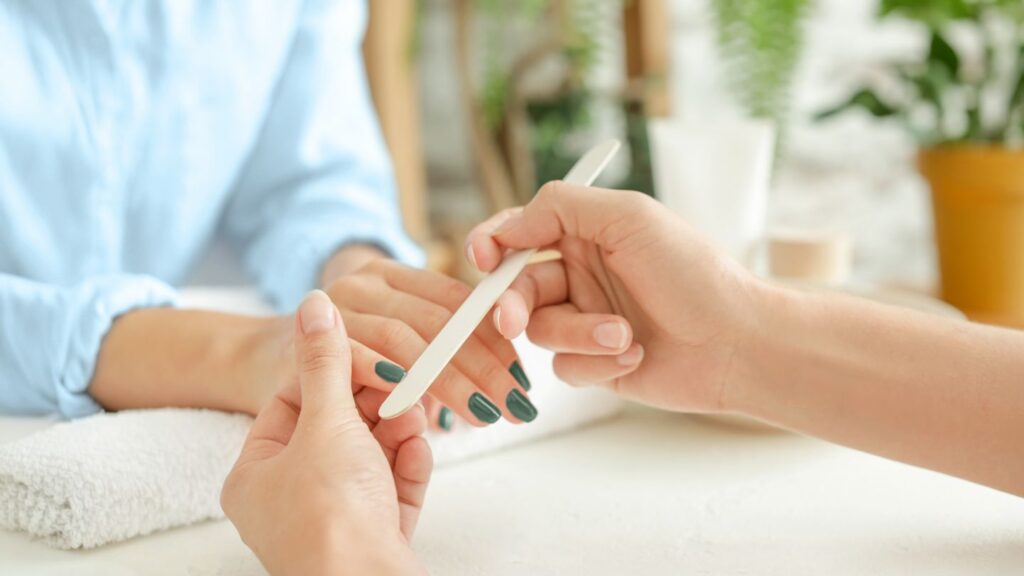
The Health Risks of Frequent Manicures
Before you head to the salon to get the hottest new shade of polish, consider these concerns.
Bacterial Infections
“In most cases, [bacterial infections] are mild and self-limited, but occasionally, they can progress to more serious infections or abscesses that require antibiotics or drainage,” she adds.
Your risk of bacterial infections is less about the frequency of your manicures and more about regular cuticle trauma. According to Dr. Sun, the cuticle acts as a “natural seal” between the surface of the nail and the skin. When cuticles are vigorously cut or pushed back, they can break the surrounding skin and create openings for yeast and bacteria to enter.
“Weekly aggressive cuticle manipulation is far more concerning than a gentle manicure every few weeks,” Lee explains.
If you develop an infection, avoid manicures until you’re healed. This may take several weeks, depending on the severity, Sun says.
The salon you choose is just as important as how often you go. Some red flags to watch out for include tools taken from a drawer instead of a sealed pouch, tools not soaked in disinfectant in between clients, and nail technicians reusing nail files and buffers on multiple clients, says Geeta Yadav, MD, a board-certified dermatologist and the founder of FACET Dermatology, a private practice in Toronto.
Nail Splitting and Lifting
Manicures are one of the most common causes of onycholysis, when the nail plate separates from the nail bed — even in otherwise healthy nails, Dr. Yadav says. Manicures can lead to chemical and mechanical damage — both of which can cause issues like splitting, lifting, or peeling.
Mechanical damage occurs when gel extensions or other nail enhancements place physical stress on your natural nails, or when aggressive buffing and filing thin them out. Processes such as acetone soak-offs for gel removal can cause chemical damage, leaving your nails dehydrated and brittle.
Allergic Contact Dermatitis
“Many people assume that because they have used a product for years, it cannot suddenly cause a reaction. In reality, allergic contact dermatitis commonly develops after repeated exposure over time,” Kazlouskaya explains.
Symptoms include burning, redness, itching, nail changes, scaling (flaky and dry patches of skin), and eczema around the fingers. Rashes on the face, eyelids, or neck can also occur from touching those parts of the body, according to Lee.
Once you develop an allergy, you should avoid all types of manicures to prevent future reactions. If you don’t, your symptoms can become more severe over time, Dr. Alford warns.
Skin Aging
There’s no universal guidance for how often you can safely get a gel manicure, says Nicole Lee, MD, MPH, a board-certified dermatologist in private practice at Epoch Dermatology in Garden City, New York. But a gel manicure every two weeks results in significantly more exposure to UVA rays than if you get one only occasionally.
Christina Sun, MD, a board-certified dermatologist and dermatopathologist with Dermatology Partners in Philadelphia, recommends alternating between gel and traditional polish and skipping gel manicures periodically throughout the year. By reducing your frequency of gel manicures, you can decrease your overall risk, she says.
Skin Cancer
But according to the Skin Cancer Foundation, even the most intense curing lamps present a moderate UV risk — and one that’s much lower than UV tanning beds.
Dr. Lee points out that many dermatologists consider photoaging a more realistic issue than skin cancer for the typical gel manicure client.
Read the full article here

