


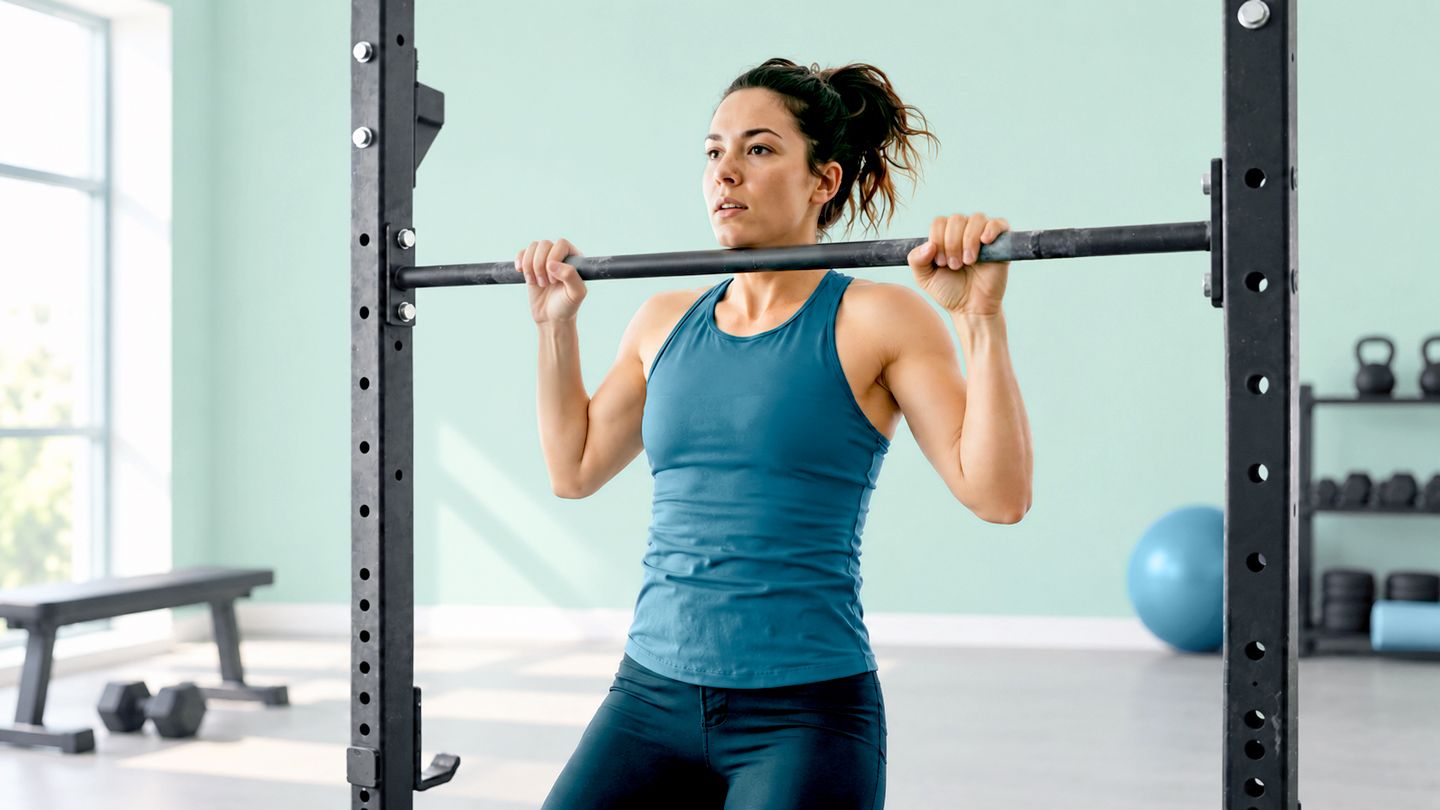
Proper Form How to Do a Pull-Up (Correctly) Performing pull-ups with proper form is key for building strength and preventing injury.e60dc2a1-f33c-4a05-9b50-8e3e8e597629703c9c04-03ff-47e9-a8fb-ee0c1e55dee5 Technique is important when doing pull-ups, says Domenic Angelino, CSCS , the chief exercise scientist at FitCraft (a gamified fitness app) and an ACE-certified personal trainer based in Providence, Rhode Island. Try not to swing to gain momentum to get yourself up to the bar. This interrupts your form, uses your hips (instead of your upper body) to help you up, and diminishes the strength benefits of the pull-up, Angelino says. Here’s how to do one properly, according to the National Academy of Sports Medicine.e60dc2a1-f33c-4a05-9b50-8e3e8e5976291b82a34a-86f0-4cf1-9a66-129f74b4639a Stand under a pull-up bar and jump up to grip it, with your hands slightly wider than shoulder width, palms facing away from you. Engage your core and pull your shoulder blades down and back . To initiate the exercise, pull your elbows down to lift your body until your chin is over the bar. Pause briefly before lowering with control.
Muscles Worked What Muscles Do Pull-Ups Work? Pull-ups aren’t just an upper-body exercise. “Pull-ups work many of the big muscles throughout your body,” says Sharon Gam, PhD, CSCS , an exercise physiologist and the founder of Lifted Strength Club, a gym in Orlando, Florida. She says that the primary muscles you’ll target are those in the back , which include the latissimus dorsi (the large, fan-shaped muscles below your shoulder blades), trapezius (smaller muscles that begin at the neck and extend across your shoulders and down to your lower back in a V shape), and rhomboids (medium-sized muscles that connect your shoulder blades to your spine).e60dc2a1-f33c-4a05-9b50-8e3e8e597629f09d29df-578b-4e17-971f-01cfa9c64d94 You’ll also engage your shoulder muscles, specifically the four rotator cuff muscles that cup the front of the shoulder, as well as the rear deltoids (the muscle in the back of your shoulder).e60dc2a1-f33c-4a05-9b50-8e3e8e5976298ed58cf7-a2bd-4271-b130-e03596a54402 In addition, pull-ups recruit the arms (biceps), chest (upper pectorals), and abdominal muscles, Gam says. The muscles that are most active differ depending on the phase of the movement. During the concentric phase (the pulling up), the lats do the bulk of the work. Meanwhile, the smaller stabilizing muscles like the rhomboids, rear deltoids, and rotator cuff muscles are activated during the eccentric phase (the lowering down), Gam says.
Exercises How to Train to Do Your First Pull-Up When you’re just starting out, perform a modified pull-up variation such as a band-assisted pull-up, Gam says. To do it, loop a resistance band around a pull-up bar, and then stand or kneel on the band while performing a pull-up.e60dc2a1-f33c-4a05-9b50-8e3e8e597629532e3c6b-a4bf-48a9-9cbe-745a5f9d1f4f You can also use an assisted pull-up machine if your gym has one. With this machine, you kneel on a platform and pull up to the bar. The benefit of these options is that the band or machine supports some of your body weight, making it easier to pull yourself up. You can adjust the resistance on both of these to make the movement harder or easier as needed. Aim for 3 sets of 12 to 15 reps when performing assisted pull-ups, Gam says. “High reps provide plenty of practice for your nervous system to learn how to do the movement properly,” she says. Once 12 to 15 reps feel easy, reduce the assistance level on the machine (or use a lighter resistance band) and do 3 sets of 8 to 12 reps. Once that feels easy, reduce the assistance and do 3 sets of 6 to 8 reps, Gam says. In addition to assisted pull-ups, several exercises will train your body how to perform the pull-up movement and build the muscular strength you need. Angelino recommends doing 1 to 3 sets of the following exercises twice weekly. Dead Hangs Dead hangs help build the grip strength needed in a pull-up, Angelino says. How to Do It Stand under a pull-up bar and jump up to grip it, with your hands slightly wider than shoulder width, palms facing away from you. Hang from the pull-up bar with arms straight; let your body weight relax to stretch your shoulders. Aim to hold for 10 to 20 seconds. Build up to longer holds as you get stronger. Modify by using an assisted pull-up machine or looping a resistance band around the bar and standing or kneeling on it.
Negative Pull-Ups The goal of this exercise is to train yourself to do the downward portion of the pull-up with control.e60dc2a1-f33c-4a05-9b50-8e3e8e59762939d1d141-74dc-400d-b8e4-7f3c8316a993 How to Do It Position a bench or sturdy box beneath a pull-up bar. Step onto the bench with both feet and grip the bar, with hands slightly wider than shoulder-width apart, palms facing away from you. Your chin should be above the bar. Engage your shoulder and back muscles by pulling your shoulder blades together and down your back. Step off of the bench and slowly lower your body down to the ground. Let go of the bar and return to the starting position. Do 10 reps. If a negative pull-up is too challenging, use an exercise band or the assisted pull-up machine.
Achieving an unassisted pull-up is a major fitness goal for many. This move challenges your upper body muscles — namely those in your shoulders, upper back, and arms — to resist gravity and lift your entire body off the floor. Doing just one is enough to make you feel strong and capable. Reaching this goal takes hard work. Here’s how to do it.
How Many to Do How Many Pull-Ups Should You Be Doing? If your goal is to perform an unassisted pull-up, Gam recommends training them at least twice a week. This includes practicing pull-ups themselves, along with other strength training exercises that build the skills needed for an unassisted pull-up. (More on how to get there below.) There’s no official consensus on how many pull-ups you should be able to do . “Pull-ups can be easier or harder for specific individuals depending on their body weight, starting strength, and movement abilities,” Gam says. However, if you’re just starting out, working toward one unassisted pull-up is a great goal, she says. Once you achieve that unassisted pull-up, you might try increasing that number. Keep in mind that training for pull-ups isn’t sufficient to keep you fit. Pull-up training should be part of a comprehensive exercise program that includes 150 minutes of moderate-intensity aerobic exercise and two full-body strength workouts per week.e60dc2a1-f33c-4a05-9b50-8e3e8e59762961d93f99-0403-4fd9-93cc-dfec44d7e1a0 Before training pull-ups, make sure the movement is safe for you. Talk to your doctor if you have joint issues or are recovering from an injury, particularly if it’s a shoulder injury , Gam says.
Seated Lat Pulldown This move, which uses a seated lat pulldown machine, targets the lat muscles that power the pull-up. How to Do It Sit on the seated lat pulldown machine and grip the bar above you with palms facing down. Pull your shoulders down and lean back slightly. Pull the bar down toward your chest (not behind the head), drawing your elbows into the sides of your body. Keeping your movements controlled, allow your arms to extend overhead again. Do 10 reps.
Read the full article here


Leave a comment
