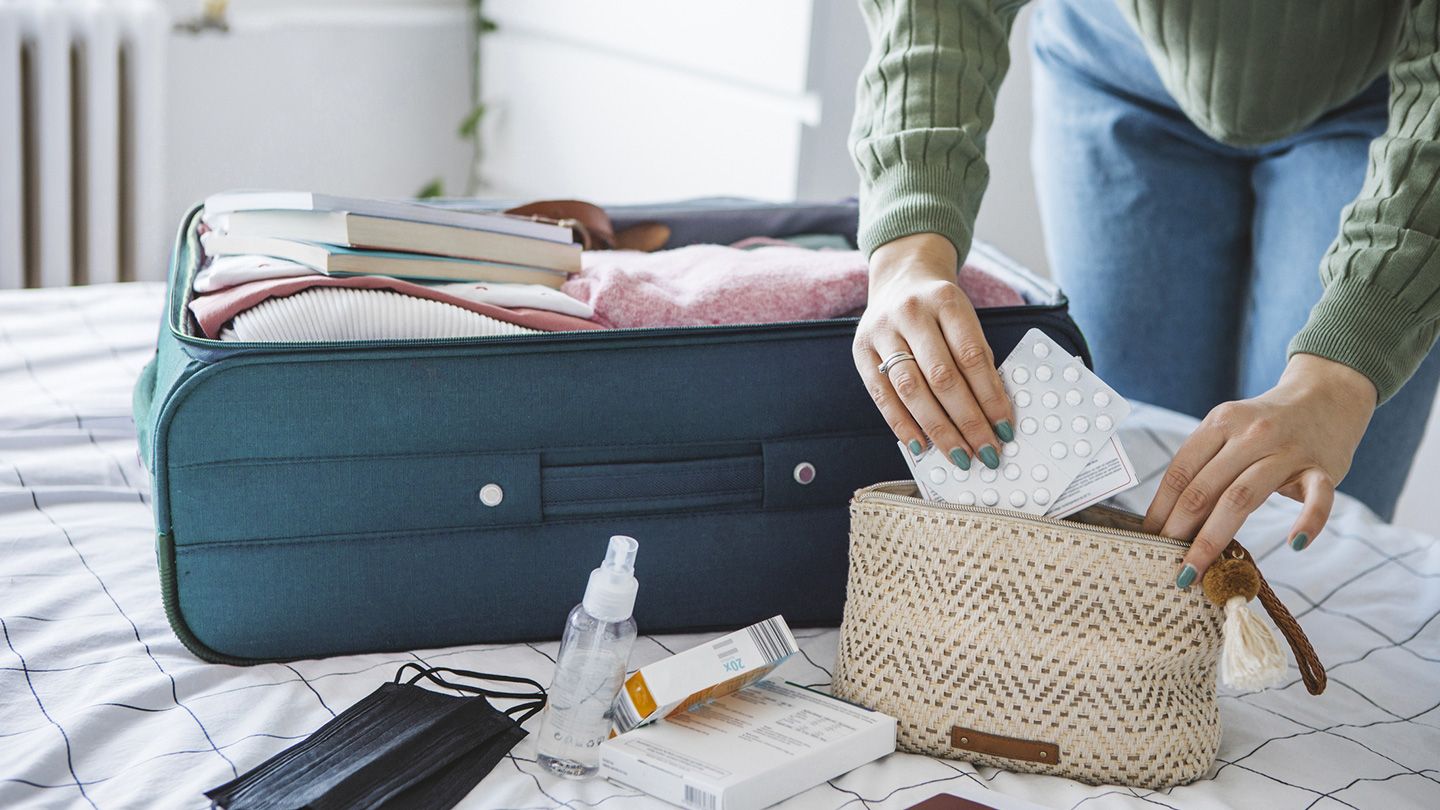
2. Manage Medications on the Move
Making sure you’re all set with medications and vaccinations before you leave is crucial.
Schedule Vaccines, if Needed, Before You Travel
Talk to your care team well in advance of your departure date — some live vaccines must be given four weeks before or three months after immunosuppressive therapy, for example, and certain vaccines require multiple doses, with time in between each dose, for full protection.
People with UC may need the following vaccinations, especially if they’re taking medications that affect the immune system:
- COVID-19 (Pfizer, Moderna, Novavax)
- Flu
- Pneumococcal (Vaxneuvance, Prevnar 20, Pneumovax 23)
- Recombinant herpes zoster virus (Shingrix)
- Human papillomavirus (HPV) 9-valent (Gardasil 9)
- Hepatitis B (Heplisav-B, Engerix-B, Recombivax HB)
- Measles, mumps, and rubella (MMR II, Priorix)
- Varicella zoster (Varivax)
Make Sure You Bring an Adequate Supply of Medication
Having enough medication to last the duration of your trip is a top priority. This might mean requesting that your insurance issue a vacation override at the pharmacy, which allows you to fill prescriptions early, either by calling your insurance company a week or two ahead of your trip or asking your pharmacy to process it for you.
Do what you need to avoid running out of medication during a trip. “Missing medication doses can cause flare-ups of your colitis, which we want to avoid,” Dr. Choden says.
Schedule Infusions or Injections for Before or After Your Trip, if Possible
If you’re receiving infusions or self-administering injectable medications, make sure you have them scheduled, so you can travel without risking increased symptoms or a flare.
Schedule changes can be a challenge with some infusions or injections, due to insurance coverage, so timing a vacation around the medication dosing would be the best idea, Choden says. Occasionally, you may be able to ship your medication, such as an injection, to another location, she says, though this isn’t possible if you’re traveling out of the country.
“This is about working with your care team,” says Joanna Melia, MD, a gastroenterologist specializing in inflammatory bowel disease at Johns Hopkins Medicine in the Baltimore area. “In general, for patients on infusions, I readily allow a dose one week early or one week late to accommodate travel. My preference is generally to give a drug earlier rather than later, especially for drugs [that cause more of an immune response], like infliximab [Avsola, Inflectra, Remicade].”
And Dr. Melia says that there’s no reason to adjust the schedule of your daily oral medications — you can take them at your usual times, unless that schedule would be inconvenient to keep up in the time zone you’re traveling to.
Consider Bringing Emergency Medications
It can ease fears to travel with specific emergency medications in reserve, should you need them. “For some of my patients, taking a prescription for prednisone provides a level of ‘just-in-case’ security that gives peace of mind,” Melia says. “But the patient-provider relationship is really important, as is education about signs and symptoms … that would warrant therapy other than prednisone.”
The antidiarrheal loperamide (Imodium) is also something that Melia says people with UC will want to have on hand, though she suggests talking to your doctor about when to take it versus when to avoid it. One such example is if you’re having bloody diarrhea, which might indicate an infection requiring immediate medical attention rather than antidiarrheal medication. “I also consider anti-emetics [medication that helps prevent nausea and vomiting] for select patients,” she says.
“Depending on where patients are traveling, it is also important to discuss with your care team about specific destination-focused advice,” she says. Melia also recommends discussing other medications with your healthcare provider in certain situations, including antibiotics (in case of traveler’s diarrhea), or preventive medications for malaria, if either are common where you’re traveling to.
Ensure Prescriptions Are Labeled, and Consider Getting a Doctor’s Letter
Generally speaking, as long as your name is listed on the prescriptions, there shouldn’t be any issues during travel, Choden says.
Certain controlled substances may be scrutinized when traveling internationally, however, so it can give you peace of mind to have your care team document them. “For patients on self-injectable medications, it can be useful to carry a letter regarding the intent and purpose for the medication,” says Melia. “I will usually write a letter on my letterhead to explain the medication and route of administration, and any storage concerns.”
Read the full article here