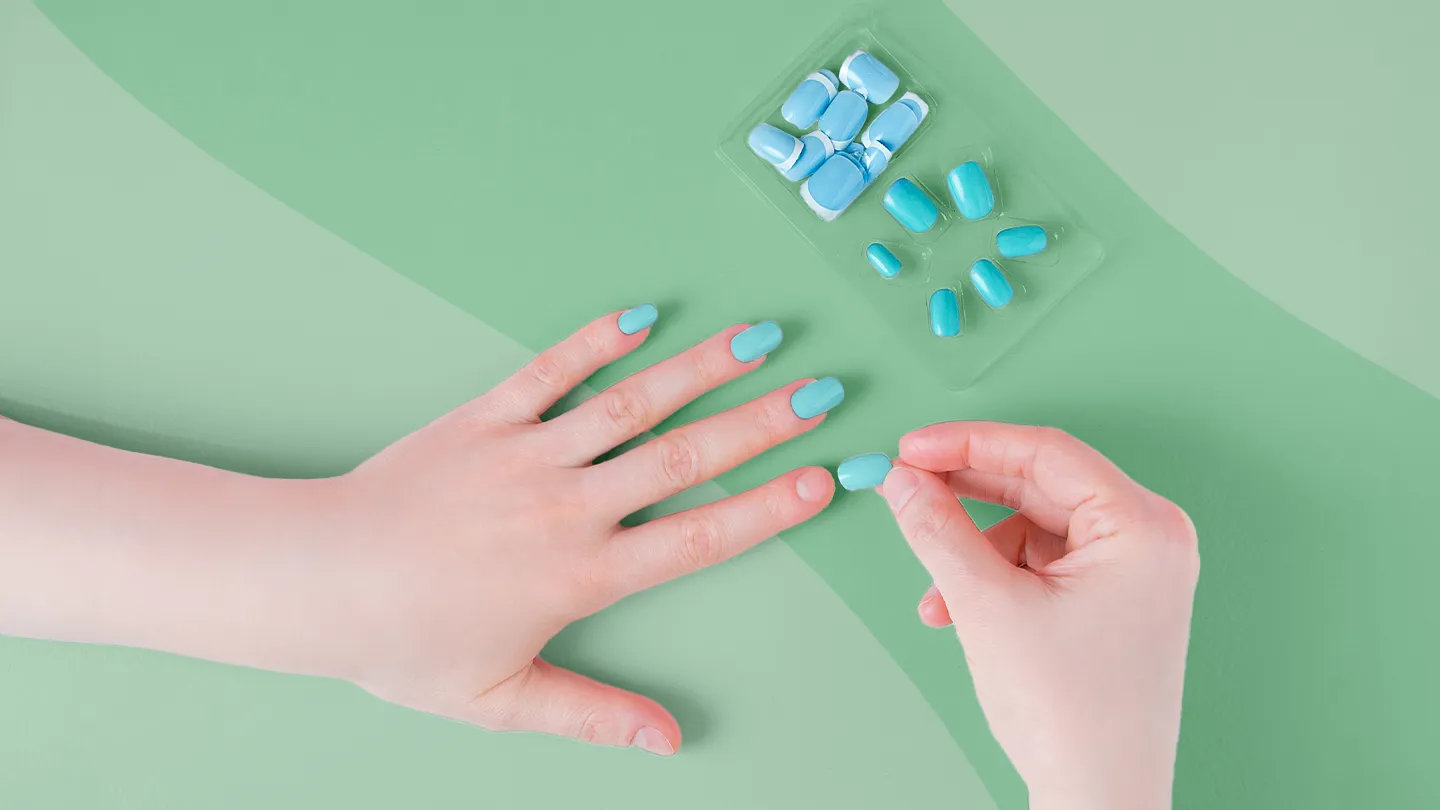
Artificial nails are a style staple in today’s world, but they can lead to a concerning outcome — fungal infection.
Fungal nail infections can occur when moisture accumulates beneath acrylic nails. They are more common when nails are left on for longer than three months or when you reglue an artificial nail before properly cleaning the gap.
While any artificial covering that seals to the nail carries risk, acrylic may be particularly problematic because of its rigid material, which eventually lifts at the edges, allowing moisture in, says Sara Moghaddam, MD, a board-certified dermatologist in Selbyville, Delaware. Press-ons can also pose a risk because their adhesive or glue may not be perfectly even, leading to air bubbles that create a reservoir of moisture. Gel nails are less risky, she notes, since their material is more flexible and tends to be applied in a uniform layer, making gaps that allow moisture less likely.
Here are eight things to know about how to prevent fingernail fungus and maintain healthy nails.
1. It’s Quite Common
“Nail fungal infection is very common,” says Viktoryia Kazlouskaya, MD, PhD, a board-certified dermatologist in New York City. “Artificial nails are not dangerous per se, but they may potentially increase the risk of developing a fungal infection in several ways.”
2. It May Spread Through Contaminated Equipment
One way artificial nails contribute to fungal infections is through dirty equipment. “If the procedure is done in a salon, you may get an infection from improperly cleaned instruments,” Dr. Kazlouskaya says.
Although there is limited research on contamination rates in the United States, one older study of 18 nail salons in California found that infection-causing bacteria were present in 97 percent of whirlpool footbaths. After that study was published, the state of California implemented new, more stringent protocols for cleaning and disinfecting foot spas in 2006. A more recent study from Iran found that 42 percent of equipment sampled from salons was contaminated by bacteria or fungi.
”While it is difficult to provide exact statistics on prevalence, it is not uncommon,” Kazlouskaya says. “I have personally seen a lack of sanitation procedures in nail salons, and many of my patients with fungal nail infections have a history of nail salon visits.”
Salons should use an EPA-registered hospital disinfectant for tools like foot spas, and staff should be able to show you on the disinfectant label. Look for labels that include the terms “disinfectant” and also “hospital,” “medical,” or “healthcare.”
It’s important to ensure the salon you’re visiting follows proper practices to keep tools sanitized and reduce infection risk. “Ask them about their sterilization process,” Dr. Moghaddam says. “Metal tools should be heat-sterilized in an autoclave — a UV light box is not sufficient for sterilization — and presented to you in a sealed pouch.”
Meanwhile, files and buffers should be new for each client, Moghaddam adds.
Also, make sure your technician does not use overly aggressive filing or drilling techniques that damage your natural nail.
“A red flag would be if you feel a flash of heat or a stinging sensation while they are filing, which means the nail is being thinned so much that the friction heat is reaching the sensitive nerves in your nail bed,” she says. “Another red flag would be red grooves or crescent marks, which means the drill has filed too deeply into the nail plate.”
You can check online to ensure your spa has an active license with your state licensing board. You should never visit an unlicensed salon.
3. Applying Fake Nails Can Put You at Risk
Artificial nails can easily trap moisture from handwashing or other everyday activities, Moghaddam says.
“The space between the natural nail and the artificial nail material is a perfect incubator for fungus,” she says.
“The process of filing, drilling, and applying artificial nails can thin or damage the natural nail plate,” Moghaddam says. “This micro-trauma creates tiny cracks and openings, giving fungus an easy entry point.”
If your manicurist positions artificial nails incorrectly during application, this can also allow fungus to grow.
“If you run your fingers through your hair and the hair is snagging around the edges of the nail, the product is already lifting or wasn’t sealed correctly,” Moghaddam says. “That snag is a red flag that there’s a gap and gateway for moisture to be trapped and encourage fungus growth.”
4. You Might Not Notice Symptoms Right Away
A fungal nail infection develops slowly, starting at the edge of the nail before spreading to the rest.
“The signs are often subtle at first,” Moghaddam says, adding that the following signs may appear as a result of infection.
- Discoloration The nail may develop yellow, brownish, or white spots or streaks. A greenish discoloration is also a red flag, often cause by a bacterial infection that can occur alongside or instead of a fungal infection in the moist environment under a lifted nail. This discoloration usually starts at the tip of the nail and grows toward the side.
- Thickening and Distortion The nail may become abnormally thick, brittle, or crumbly at the edges. Its shape may change or become distorted.
- Lifting of the Nail The nail plate may begin to separate from the nail bed underneath. This creates a space where debris can accumulate, contributing to an unclean environment and encouraging bacteria and fungi, which thrive in moisture.
5. Your Artificial Nails Should Be Removed at the Salon
If your fake nails are applied in a salon, return to a salon every two to three weeks for maintenance. If you have a broken or cracked nail, having a salon professional repair it rather than doing it yourself lowers the chances of developing a fungus.
6. Home Treatments May Not Be Enough
Over-the-counter antifungal nail creams and ointments are available, including terbinafine (Lamisil), which kills fungus. Lamisil is applied once daily for seven days (except for Lamisil ONCE, which is a single-application formula).
Trimming the nails before applying an antifungal can help the drug reach deeper layers. You can also try filing off white markings on your nails, soaking them in water, drying them, and applying the ointment. Though this may reduce symptoms, the infection often returns.
“I would caution against waiting too long to see a specialist, as nail infections often require oral medication for full treatment, and nails are generally difficult to treat with topical products alone,” Kazlouskaya says.
7. You Usually Need to See a Doctor for Treatment
It’s best to see your doctor or a dermatologist as soon as you notice symptoms. “A professional diagnosis is key, as other conditions such as nail psoriasis can mimic a fungal infection,” Moghaddam says. Nail psoriasis is an autoimmune condition in which your body produces cells too quickly on the skin, hair, and nails. On the nails, this can take the form of tiny dents, discoloration, crumbling, or separation of the nail bed.
Severe cases of nail fungus that go untreated can be painful and cause permanent damage to the nail, potentially even leading to infections that spread beyond your feet in those who are immunocompromised.
Oral prescriptions are usually required if the fungus affects several nails or if it is spreading on the affected nail.
An oral prescription form of terbinafine is available, with a treatment course of about three to four months (not to be confused with the OTC topical version of terbinafine). Fluconazole is another oral medication a doctor may recommend if other treatments don’t work well enough, with a treatment course of 6 to 12 months.
“Oral antifungal medications like terbinafine or fluconazole are the gold standard,” Moghaddam says. “These drugs work systemically, allowing the medication to reach the nail bed and grow out a new, healthy nail.”
Other prescription options include medicated nail polish, medicated nail cream, or even surgery to remove the nail so treatment can be applied directly to the infection.
“First, a healthcare professional may need to run some tests to confirm that it’s truly a fungal infection,” Kazlouskaya says. “A simple nail clipping and lab test can usually provide a definite answer.”
8. Give Your Nails Regular Breaks
It’s important to take a pause from artificial nails every two to three months to prevent infection.
“Give your nails a break from artificial coverings for at least a few weeks,” Moghaddam says. “This allows your natural nails to recover and gives you a chance to inspect them for any early signs of trouble.”
Taking a break means allowing the nails to be completely bare, with no chemicals or products applied. Instead, Moghaddam recommends applying petroleum jelly to the nail and cuticle a few times a day to hydrate and protect them.
If you do have artificial nails with lifting or gaps, keep in mind that moisturizing can inadvertently push moisture into those pockets, Moghaddam adds.
“After washing, dry your hands thoroughly before applying any product,” Moghaddam says. “Also, if you feel a nail is lifting or snagging in your hair, skip the heavy moisturizer on that finger until you can get the nail fixed.”
The Takeaway
- Fingernail fungus from fake nails can occur as a result of unsanitary tools, prolonged usage of artificial nails, or incorrect application and removal.
- Best practices for artificial nail hygiene include vetting the salon you visit for cleanliness by ensuring it is licensed and follows proper sanitation protocols, and giving your natural nails regular breaks.
- If you notice signs of fingernail fungus, see your doctor right away, as prescription oral medication is often the first-line treatment, and it’s best to get ahead of it, so it doesn’t lead to pain or permanent damage.
Read the full article here