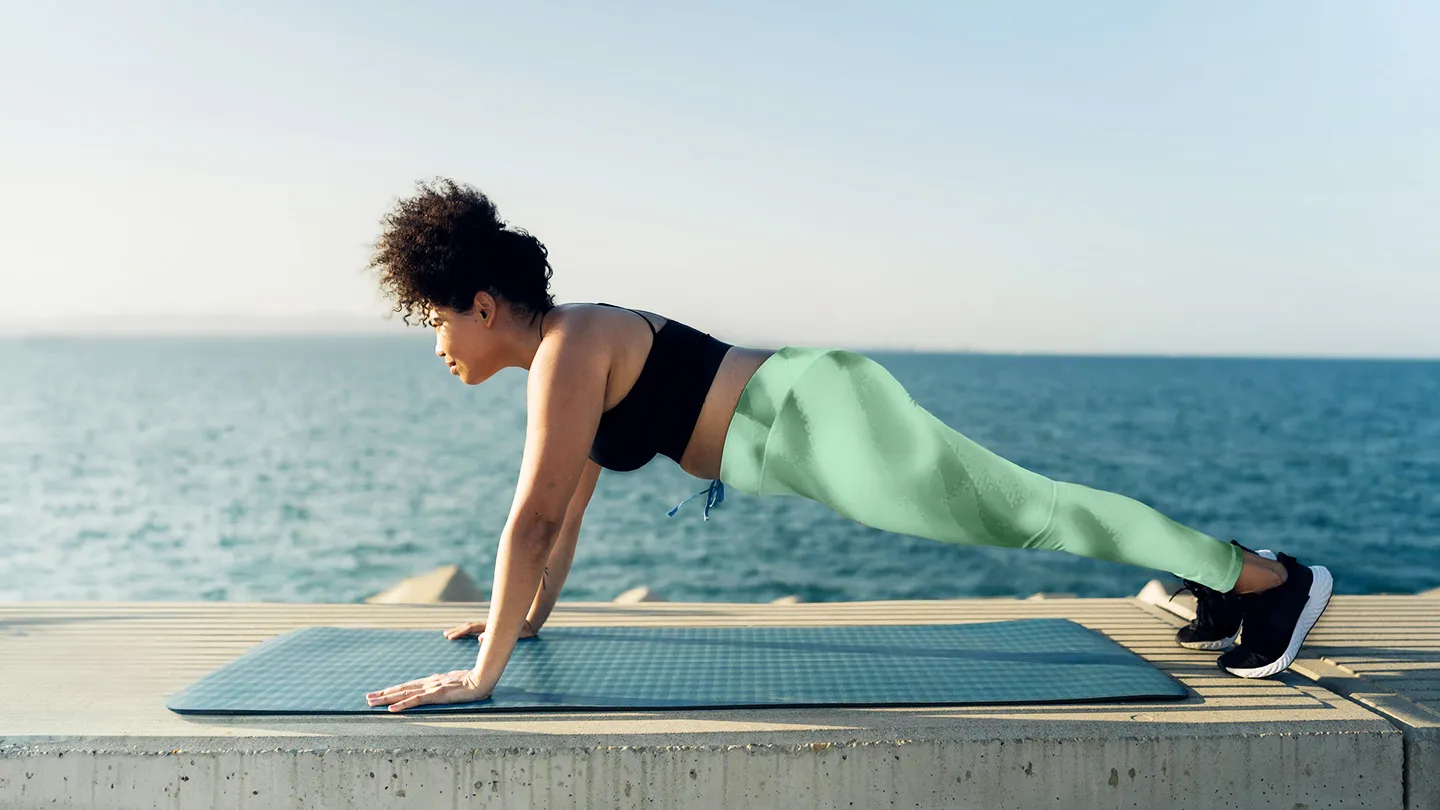
While it may seem counterintuitive, using resistance exercises to strengthen your chest muscles can play an important role in your recovery from a shoulder injury. The chest muscles not only influence your ability to move and rotate your arm but also provide stability to the front of the shoulder joint. Many exercises target this important muscle group and are able to help relieve shoulder pain; of the seven below, none should increase the ache — but be sure to speak with your physician or physical therapist before adding them to your routine. Once you get the all-clear, aim to do them a few times a week, completing 10 reps and 2 to 4 sets for each move.
Chest-Building Exercises
1. Cable Flyes
This exercise helps activate the pectoralis major, the largest and bulkiest muscle in the chest.
How-to: Stand before a cable column and take a pulley in each hand. Assume a staggered stance. Slowly bring your hands together at shoulder level. Hold for a few seconds, then release.
2. Push-Ups
Push-ups use the weight of your body to strengthen the chest muscle group.
How-to: With your hands positioned under your shoulders and your elbows straight, get into a plank position on your toes. Bend your elbows and slowly lower yourself down until your chest grazes the floor (or until your elbows are even with your shoulders). Hold for 1 to 2 seconds, then return to the starting position. If a standard push-up is too strenuous for your shoulders, modify the exercise by performing it on your knees.
3. Dips
Dips help activate your pectoralis minor, a smaller chest muscle under your pectoralis major.
How-to: Grasp a set of parallel bars with your hands and elevate your body by locking your elbows and bending your knees. (If this proves too tough for your shoulders, you can start by supporting your legs on a stool or chair.) Lean forward slightly, bend your elbows, and slowly lower yourself down 6 to 12 inches. Stay there for 1 to 2 seconds, then straighten your elbows to lift yourself again.
4. Bench Press
Bench presses are another great way to target the pectoralis major and minor.
How-to: Lie on your back on a weight bench. Grip a barbell above you, with each hand placed on the bar just outside your shoulders. Slowly lower the bar until it lightly touches your chest and then extend your arms to elevate it again. (If this hurts your shoulders, stop before the bar touches your chest, or when your elbows are parallel to the ground.) Some studies suggest that adjusting the weight bench incline by 30 to 45 degrees further benefits the upper pectoralis major.
5. Chest Press
This dumbbell exercise can isolate an injured shoulder and activate the pectoralis major muscles, helping to improve stability in that area.
How-to: Lie down on a weight bench with a dumbbell in each hand and bend your elbows at 90-degree angles. Extend your arms and lift the weights straight up in the air. Hold for 1 to 2 seconds, then lower the weights back down.
6. Swiss Walk-Outs
Walk-outs challenge the chest muscles to stabilize the front part of an injured shoulder while dealing with the instability of a Swiss ball.
How-to: Lie down on your stomach over a Swiss ball and place your hands on the floor. Walk forward onto your hands as you allow the ball to roll down your body toward your ankles. Keep your spine straight, and your abdominal muscles engaged. When the ball reaches your feet, reverse course and “walk” it back up toward your stomach again. (To make this exercise easier, you can stop the walk-out when the ball gets to your knees.)
7. Punch-Outs
Punch-outs target your serratus anterior muscles, which attach to the upper ribs of your chest and support your shoulders’ range of motion.
How-to: Lie on your back with your arms held in the air at shoulder level and grip a pair of dumbbells. Punch the weights away from your body by rounding your shoulder blades forward. Hold this position for 1 to 2 seconds, then return to the previous position without unlocking your elbows.
Read the full article here