


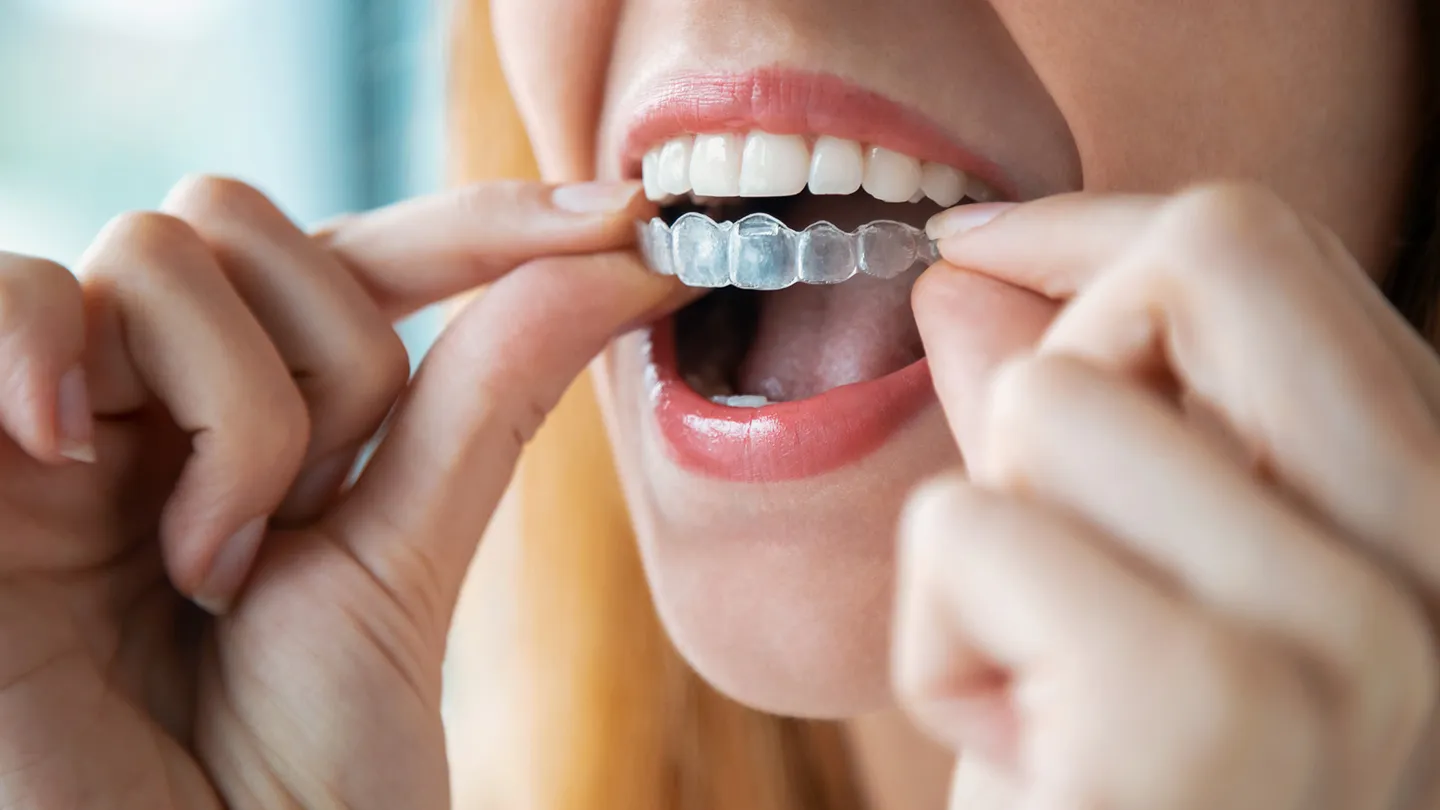
Invisalign is one brand of clear aligners, also known as invisible braces. Like traditional metal braces, clear aligners are orthodontic devices that move teeth to fix problems like:
- Crooked teeth
- Gapped or crowded teeth
- Teeth malalignment, such as an overbite or underbite
Clear aligners are custom-made mouthpieces (also called shells or trays) molded from a thin, plastic-like material. They apply pressure to the teeth, guiding them to the desired position.
Clear aligners come in sets that are worn in sequence, with each aligner typically worn up to 22 hours a day for a week.
Braces consist of brackets affixed to your teeth, along with wires and sometimes elastic bands that are used to apply pressure that moves teeth to a desired position. They are typically adjusted at an appointment every 4 to 12 weeks, depending on your treatment plan.
Unlike nearly invisible clear aligners, braces tend to be visible. But certain materials and techniques can make braces less visible, such as tooth-colored brackets or putting braces behind the teeth.
While braces can be uncomfortable when they are first placed or adjusted, most people adapt fairly quickly so that both braces and clear aligners cause minimal lasting discomfort.
For both braces and clear aligners, the overall duration of treatment will vary based on individual factors. Treatment with braces typically lasts 12 to 24 months. However, in some cases it may take longer. Treatment with clear aligners, on the other hand, may require less time, depending on how complex a person’s case is.
Cost Comparison
The price for braces or clear aligners depends on individual factors, and there’s no rule of thumb for which costs more. You’ll need to see an orthodontist for an estimate tailored to your needs.
According to Jose A. Bosio, BDS, MS, division chief and orthodontic program director at the University of Maryland School of Dentistry in Baltimore, braces are often more affordable, ranging in price from $3,000 to $7,000 compared with $4,000 to $8,000 for clear aligners.
But, he adds, “many practices are now fabricating their own aligners inside their facilities, which lowers the cost” — something that newer technologies have made possible.
While dental plans vary, insurance providers with orthodontic coverage often pay for both options.
Read the full article here


