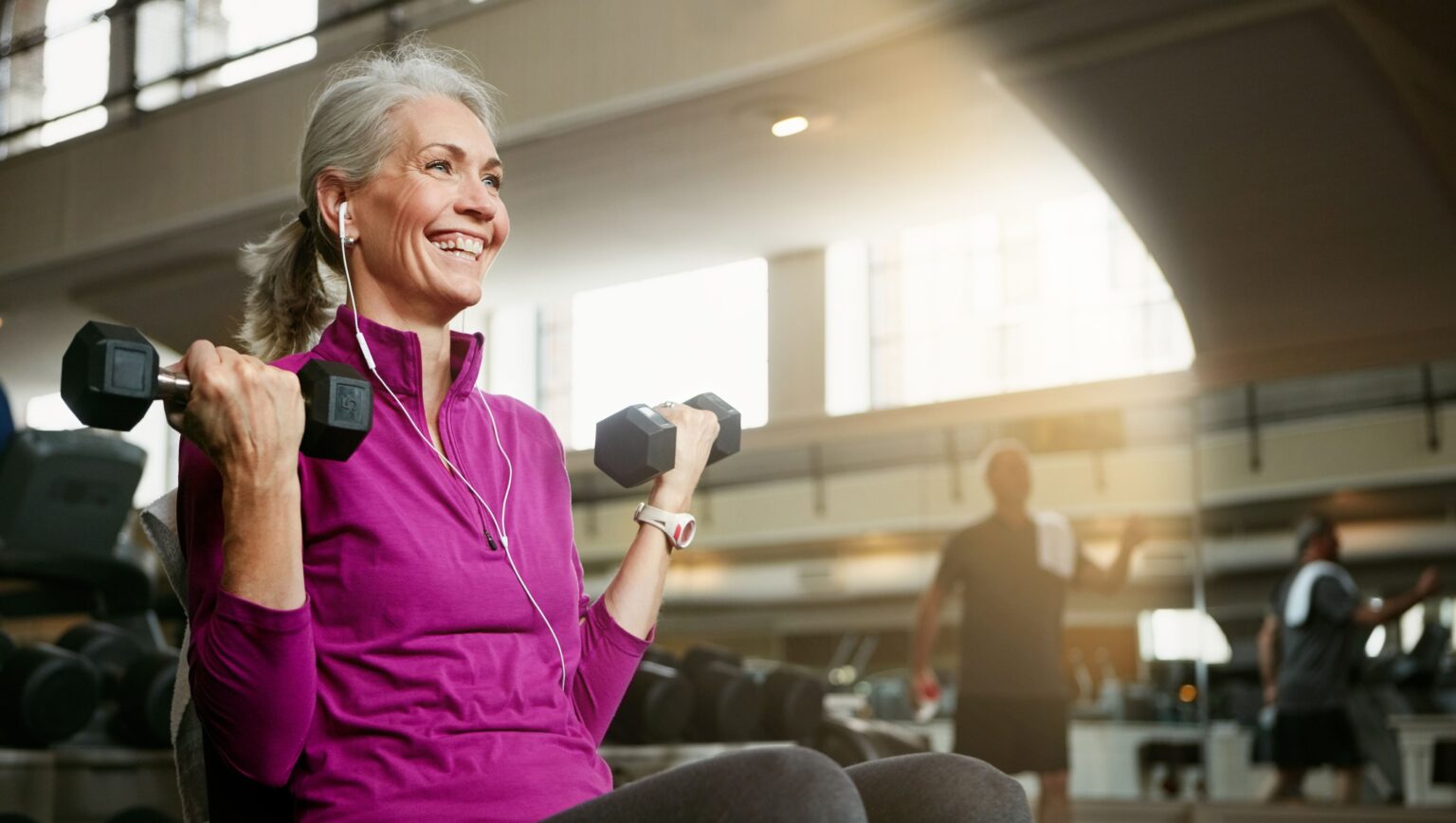
A Full-Body Workout to Manage Menopause Symptoms
All you need is a set of dumbbells or a kettlebell for this workout from the hormone-balancing fitness expert Debra Atkinson, CSCS, the creator of Flipping 50, which helps women over 50 get and stay active. It’s a quick and simple way to target all the major muscle groups in under 20 minutes.
Warm-Up
Do: 5 minutes of dynamic stretches and walking or jogging in place.
The Workout
Do: 15 to 20 reps for each exercise and repeat the following circuit two times through.
- Squat
- Bent-over row
- Chest press
- Plank
As you get stronger, try increasing the weight you use and doing 2 to 3 rounds of 12 to 15 reps for each exercise.
Move 1: Squat
The squat is a compound exercise, meaning it targets multiple muscles and joints at the same time. And by strengthening the muscles in your lower body and core, you’re able to move easier and perform daily tasks better.
- Stand with your feet a little wider than shoulder-width apart and your arms at your sides.
- Extend your arms out in front of you as you slowly bend your legs to squat down. While bending, focus on pushing your hips as if you’re going to sit in a chair.
- Squat down until your thighs are parallel to the floor. To prevent the knees from caving in or outward, keep them lined up with your toes. Your arms will still be out in front of you, and your gaze will be straight ahead.
- Pause in this position. Exhale, and reverse the move by pressing into the mid-foot to straighten legs and stand up. As you rise, lower your arms back to your sides.
You can do squats as either a body-weight exercise (as described above) or add a set of dumbbells (held at your side throughout the move) or a kettlebell (held in front of your chest) for more resistance.
Move 2: Bent-Over Row
The bent-over row is another compound exercise that targets your upper back, arms, and core. Since the risk of developing osteoporosis increases as you age, strength-training exercises for the back are one of the best things you can add to your exercise program.
- Hold a dumbbell in each hand and stand with your feet shoulder-width apart.
- Bend your knees slightly and hinge your torso forward by bending at the waist.
- Keep your upper body still and lift the dumbbells to the sides of your chest with your elbows pointing toward the ceiling.
- Squeeze at the top and pause.
- Slowly lower the weights to the starting position.
Move 3: Chest Press
Another compound exercise, the chest press targets the muscles in your chest and shoulders, allowing you to work all the pushing muscles at once. A chest press mimics the traction and pressure on your shoulder joints that can occur with many movements you’ll carry out every day. This makes the chest press a good option for strengthening the chest and shoulders for daily function.
- Lie on your back on the ground with a dumbbell in each hand.
- Bend your knees and extend your elbows to 90 degrees. The backs of your arms will touch the floor.
- Press the dumbbells up over your chest until they’re almost touching. The elbows shouldn’t be locked out. Pause.
- Lower the weights back down to the start and repeat.
Move 4: Plank
If there’s one exercise that puts your core muscles to the test, it’s the plank. This move not only targets the core muscles as a whole but also engages muscles from head to toe. And having a strong core helps prevent lower back pain, improve your posture, and build your balance and stability, as well as supporting your ability to perform physical activities more easily.
- Start on all fours, then press up as if you were going to do a push-up — hands shoulder-width apart and directly under your shoulders. Your body should be in a straight line from your shoulders to your ankles.
- Bring your belly button to your spine to engage your core muscles and squeeze your glutes.
- Hold this position for 30 seconds. As you get stronger, increase your time by 10-second intervals, up to 60 seconds.
If you’re unable to keep your spine in a neutral position, drop to your knees.
Cooldown
Do 5 minutes of stretching for the legs, shoulders, chest, and arms.
Read the full article here