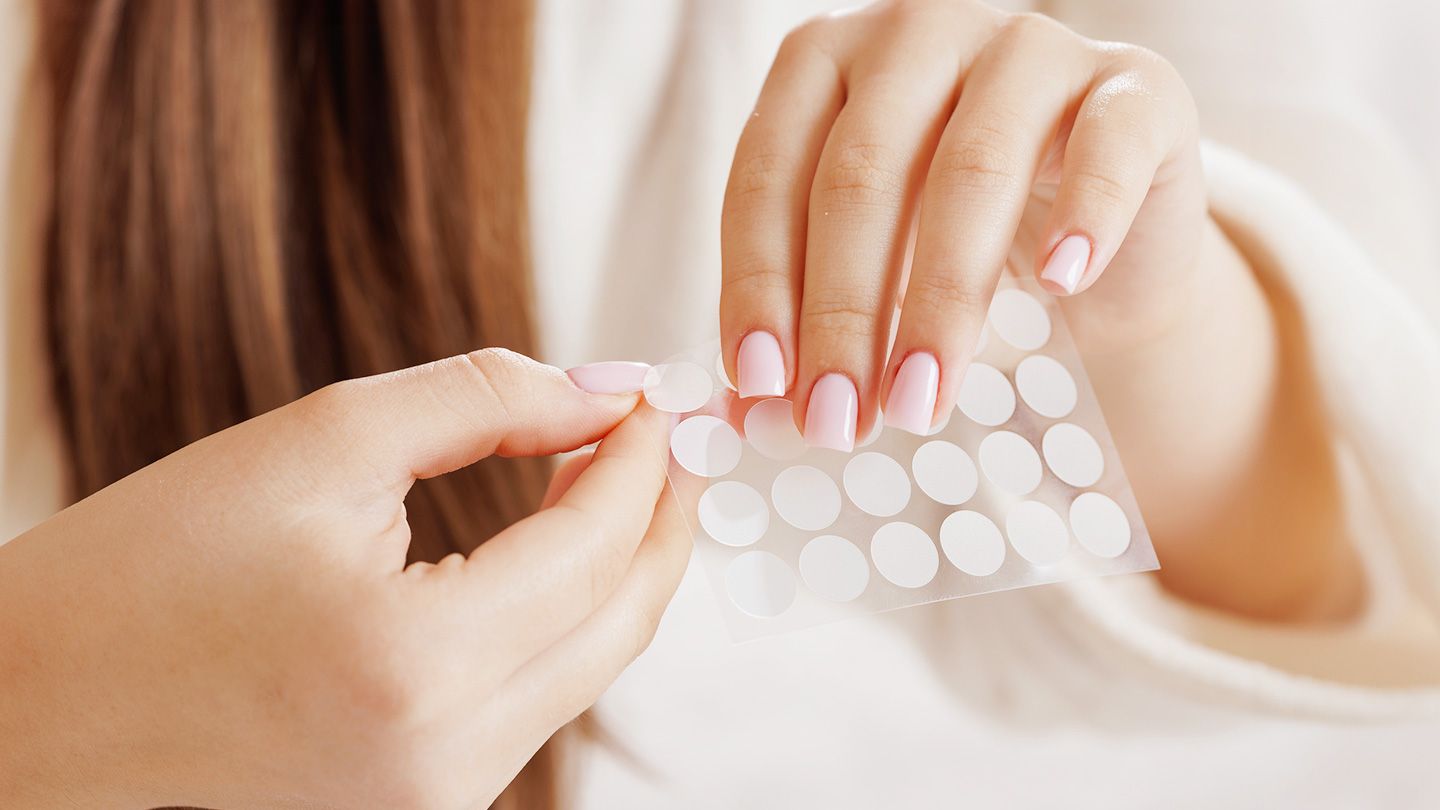
If you’ve spotted people sporting heart- or star-shaped stickers on their faces you may be wondering if you’re missing out on a quirky fashion trend. Pimple pitches, used to cover and soothe unwanted spots, deliver a topical medication to resolve the blemish while hiding it.
But they’re not one-size-fits-all, and it’s not always as easy as popping one on. Common missteps can make your pimple patch less effective or even detrimental to your skin.
1. You’re Using Them on the Wrong Acne Type
“Pimple patches are not as effective for widespread acne because they are limited in how much surface area they can cover,” says Marisa Garshick, MD, a board-certified dermatologist at MDCS Dermatology and a clinical assistant professor of dermatology at Weill Cornell Medicine in New York City.
Hydrocolloid patches — one type of pimple patch made of gel-forming materials that promote healing by drawing fluid, oil, and dirt from the pimple — are best for papules and pustules (red bumps or pus-filled pimples).
“Since hydrocolloid patches help to draw out fluid, they may help for traditional pimples, but are not as effective for blackheads, which tend to require ingredients like salicylic acid and retinoids to penetrate and unclog the pores,” Dr. Garshick says.
2. You’re Keeping Them On for Too Long (or Not Long Enough)
Pimple patches are designed to be left on your skin for at least six to eight hours — for instance, overnight after cleaning your face.
Hydrocolloid needs time to absorb fluid and help a blemish flatten, Garshick says. “When worn for fewer than six hours, the patch often hasn’t had enough time to swell, which is a sign it has not absorbed fluid and done its job,” she adds.
On the other hand, leaving a patch on for too long — beyond eight hours — doesn’t necessarily make it more effective.
Once the hydrocolloid patch has absorbed as much as it can, it’s essentially done, and prolonged wear won’t have any additional benefit, Garshick says. “For some people, especially those with sensitive or acne-prone skin, that can lead to irritation or even clogged pores around the area,” she adds.
3. You’re Combining Them With Other Active Ingredients
Pimple patches come in two forms: medicated and nonmedicated. Nonmedicated patches contain only hydrocolloids, says Angela J. Lamb, MD, an associate professor of dermatology at the Icahn School of Medicine at Mount Sinai in New York City.
Medicated pimple patches also include active ingredients, such as salicylic acid (to exfoliate dead skin cells and unclog pores — but still typically not enough to treat blackheads), niacinamide (to reduce inflammation and regulate oil production), benzoyl peroxide (to kill acne-causing bacteria), and tea tree oil (as a natural antimicrobial and anti-inflammatory agent).
Apply pimple patches to clean, dry skin and avoid placing them on top of skin products that contain other active ingredients (unless your dermatologist directs you to do so), as this can increase the risk of irritation, Garshick says. (Also, avoid applying them over makeup or when skin is damp, such as too soon after showering.)
This is true for both medicated and nonmedicated patches, as the barrier-like nature of the patch can enhance the potency and penetration of the other active skin-care ingredients since it traps them on the skin — which can lead to increased irritation or sensitivity, she says. Irritation can appear as redness, flaking, dryness, burning, or stinging of the skin.
“If there are other ingredients on the skin, it may also make it harder for any active ingredient in the pimple patch to penetrate, which may make the pimple patch itself less effective,” Garshick adds.
4. You’re Applying It to Sensitive Skin
“Anyone with skin irritation from adhesives or active ingredients or allergic reactions, especially with tea tree oil or benzoyl peroxide, should avoid pimple patches,” Dr. Lamb says. Also, avoid them if you have eczema (a group of inflammatory skin conditions that produce rash-like symptoms) or rosacea (a chronic skin condition that causes redness and acne-like bumps), she adds.
You might have sensitive skin if it frequently becomes red, stings, burns, reacts to products with fragrance or active ingredients, or has increased reactions to weather changes, Garshick says.
If you have sensitive skin and struggle with acne, choose gentle active ingredients and focus on skin barrier support. Azelaic acid, niacinamide, and adapalene can be good ingredient options for people with sensitive skin, but they should be introduced slowly, Garshick says.
“Pairing these with a fragrance-free moisturizer that helps to support the skin barrier can help reduce irritation while still treating breakouts,” she notes.
5. You’re Using Them to Prevent Breakouts
While pimple patches help treat existing breakouts, they don’t necessarily prevent new breakouts.
“Pimple patches are designed to treat an existing spot and are meant to be reactive rather than preventive,” Garshick says. “They work to draw out fluid from an existing spot — but if there is no inflammation or pus buildup, applying a pimple patch won’t be as helpful.”
And while salicylic acid in some pimple patches can treat individual breakouts, it won’t prevent new pimples from forming elsewhere on your face, since patches cover only small, targeted areas, she adds.
Don’t use pimple patches to replace a traditional acne-fighting skin-care routine, says Garshick. A typical skin-care routine for acne-prone skin includes washing your face twice daily, especially after sweating, using gentle skin-care products, shampooing regularly (to prevent acne on your forehead from hair oils), and avoiding touching your face.
The Takeaway
- Pimple patches can treat the occasional breakout, but they’re not meant for widespread acne or blackheads.
- Timing also matters — pimple patches should be used for six to eight hours, on dry skin, and separately from other active ingredients.
- Do not use pimple patches on sensitive skin or in place of a regular, preventive skin-care routine.
Read the full article here