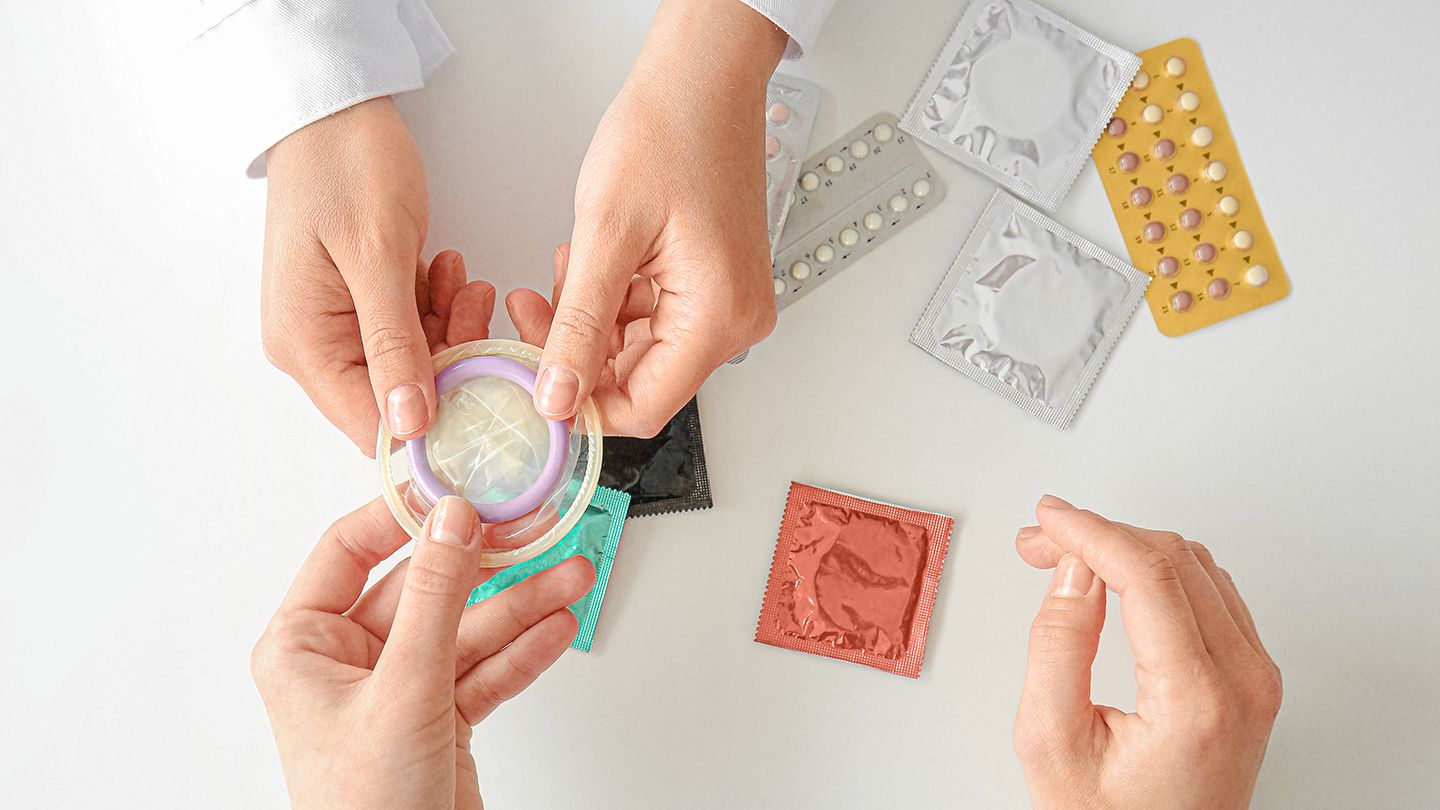
Barrier Methods
Other than condoms, these older methods of contraception typically aren’t as effective. “Sponges or a diaphragm? I don’t want to say they are outdated, but they aren’t talked about as much today by healthcare providers,” says Bond. Most barrier methods need to be inserted into the vagina before sex, so “they take away from the romance aspect of engaging in sex,” she adds.
Similarly, “a diaphragm doesn’t work that great,” says Greves. “It’s better than nothing, but I don’t remember the last time I recommended it to someone.”
On the other hand, male condoms and internal condoms remain effective forms of contraception that can also help prevent sexually transmitted infections (STIs).
Male Condoms
Your wear male or external condoms as a sheath over your penis during sex. They prevent pregnancy by stopping sperm from getting into the vagina, so it can’t reach and fertilize an egg.
Male condoms help to prevent pregnancy and can also reduce the spread of STIs. Manufacturers make most male condoms from latex. But some make polyurethane, polyisoprene, and nitrile condoms for those with an allergy to latex. Lambskin and other animal-membrane condoms also prevent pregnancy, but they don’t protect you from STIs.
How effective are condoms? With perfect use, male condoms are 98 percent effective, or 87 percent effective if used typically.
How much do they cost? Male condoms are available in most drugstores, grocery stores, convenience stores, health clinics, online, and vending machines. A box of three usually costs around $6. Lower-cost or free condoms are available at various health centers.
Internal Condoms
Internal condoms are soft, plastic pouches that you put inside your vagina or anus before you have sex. They prevent pregnancy by covering the inside of your vagina, creating a barrier that stops sperm from reaching an egg. They also help prevent the spread of STIs when you wear them in your vagina or anus.
Internal condoms were once known as “female” condoms, but people of any gender can use them. The only brand of internal condom that’s available in the U.S. is the FC2 Female Condom. It’s available online, at many health centers, and by prescription in drugstores.
How effective are internal condoms? If used perfectly, internal condoms are 95 percent effective. If used typically, they are 79 percent effective.
How much do they cost? They usually cost about $2 or $3 each. But most types of health insurance cover them if you have a prescription. Some health centers may offer them for free.
Diaphragm
A diaphragm is a shallow, flexible cup made of silicone that you put inside your vagina. It covers your cervix and serves as a barrier so sperm can’t reach an egg.
Diaphragms are most effective when you also use a sperm-killing cream or gel called spermicide.
Your doctor must fit you for a diaphragm and give you a prescription, and then you can get one at a pharmacy, drugstore, or health center. After that, you can insert it and remove it yourself.
How effective is the diaphragm? If used perfectly with spermicide, the diaphragm is 94 percent effective. With typical use, it’s 87 percent effective.
How much does it cost? A diaphragm can cost up to $75. But you can probably get a free or low-cost diaphragm through most health insurance plans, Medicaid, and some government programs. Spermicide, which is available over the counter at the drugstore, costs about $8 to $15 per kit.
Sponge
The sponge is small and round, and it’s made of soft, squishy plastic.
You insert it deep inside your vagina up to 24 hours before you have sex. It covers your cervix and contains spermicide to help prevent pregnancy. The Today sponge — the only brand of sponge available in the U.S. — is sold at pharmacies, drugstores, and some supermarkets.
How effective is the sponge? With perfect use, the sponge is 88 percent effective for a woman who’s never given birth and around 80 percent effective for a woman who has. With typical use, it’s 73 to 86 percent effective.
How much does it cost? It costs up to $15 for a pack of three. You may be able to get low-cost or free sponges at Planned Parenthood or another health center.
Cervical Cap
Like the diaphragm, the cervical cap is a silicone cup, but it’s smaller. You insert the cap deep in your vagina to cover your cervix and prevent sperm from reaching an egg. It’s also more effective when used with spermicide. FemCap is the only type of cervical cap available in the U.S.
Cervical caps are sold in pharmacies, drugstores, and health centers, but you need a prescription. A nurse or doctor will need to examine you to determine which size cervical cap is best for you.
How effective is the cervical cap? Like the sponge, the cervical cap is more effective if you’ve never had a baby. If you’ve never given birth, the cervical cap is 86 percent effective. If you have given birth, the cap is 71 percent effective.
How much does it cost? The cap costs up to $90, not including spermicide. You can probably get a cervical cap for free or at low cost with most types of health insurance, Medicaid, and other government programs.
Read the full article here