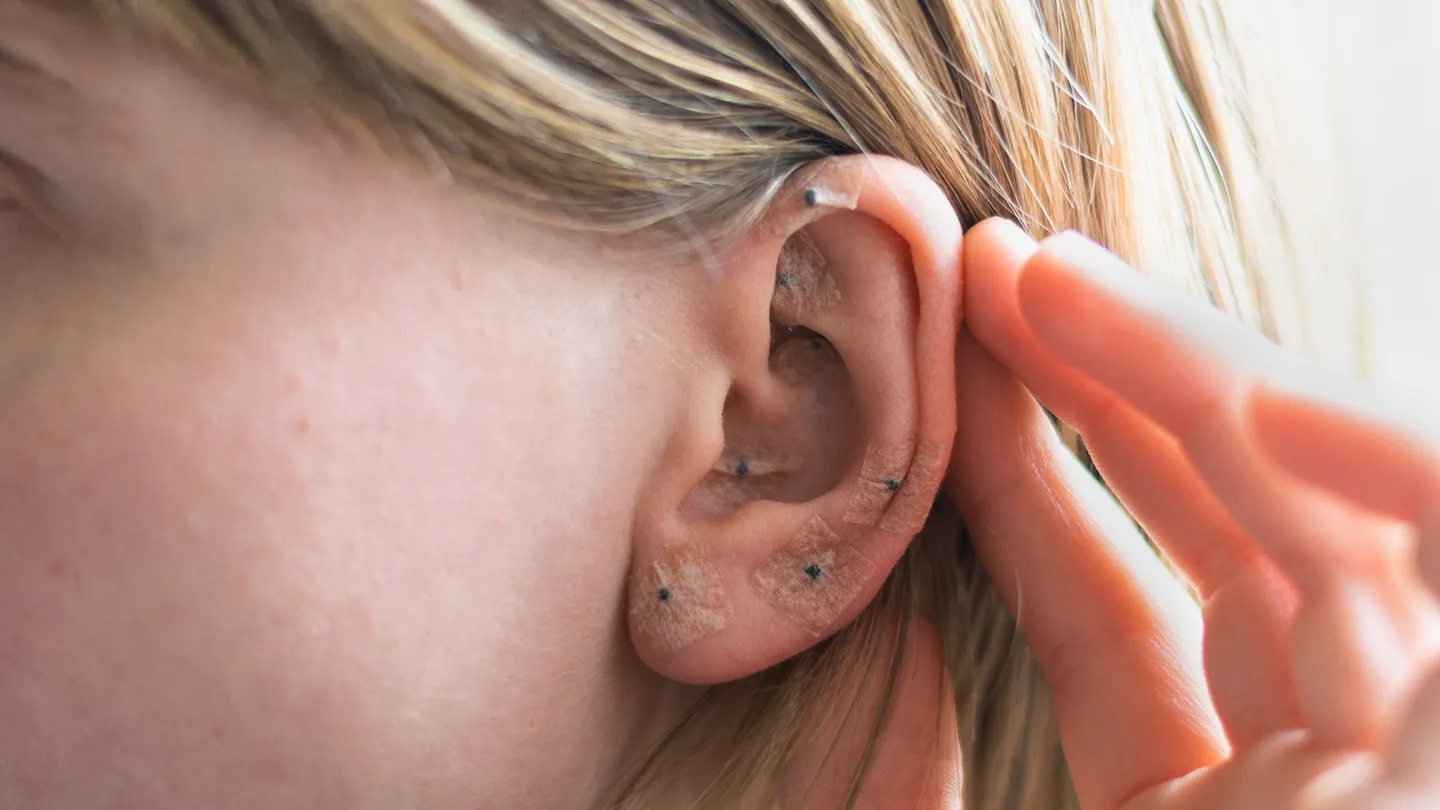
At-Home Application vs. a Visit to a Licensed Professional
Though you can buy ear seeds for at-home application, an expert should determine whether ear seeds are right for you and teach you how to properly apply them.
“I think it’s best to see a licensed professional first, because they can help you choose the most effective point to fit your diagnosis, and they can make sure you’re putting them in the correct places,” Blakeway says.
After you have first consulted with a licensed acupuncturist, Dr. Kim says applying them at home may be empowering for some people because it’s a technique that a person has control over and one that doesn’t necessarily require an appointment after your initial visit.
At-Home Application of Ear Seeds
One of the risks of applying ear seeds at home is that you might not put them in the right spots along your ear.
Indeed, the British Acupuncture Council released a statement on ear seeding that advised against applying ear seeds at home because they need to be applied to exact points along your ear.
Kim suggests limiting your seed application to between three and five seeds. “The locations may get muddled beyond that, and it also may become difficult to stimulate them,” she says.
Once the ear seeds are applied, it’s suitable for a person to massage them independently at home, according to the British Acupuncture Council.
Another risk of at-home application and massage is user error. If you massage the ear seeds too roughly or too often — more than two to three times per day — complications may arise, Chu says.
“Locally, the seeds may cause discomfort or skin irritation,” he says. “Sometimes overstimulation may cause drowsiness or dizziness, so it is important that ear seeds be placed by trained providers.”
That said, if you follow the proper technique and exercise caution, at-home application or massage of ear seeds is generally unlikely to have any adverse effects.
“The risks are minimal,” Kim says. “Theoretically, they may cause an abrasion or laceration if pressed too hard and too long, but that would be unusual.”
A slightly older research review evaluated individual auricular adverse events and found that auricular acupressure was generally safe and much less risky than forms of auricular therapy that use needles.
“Because they don’t break the skin, they are a very safe treatment,” Blakeway says.
Ear Seeding With a Licensed Professional
Most experts agree that the health risks of ear seeds applied by a licensed professional are minimal and may provide more benefits than at-home application.
A professional may also help provide more effective relief, says Christina Burns, a doctor of Chinese medicine, the founder of Naturna, and an acupuncturist in New York City.
“Having someone trained in this can help identify the best [pressure] point combinations,” she says. “They could also listen to your story and help assess where to focus.”
Read the full article here